THE HEART (AND THE ANUS) OF THE CITY
Mexico City is a knockout. It is a ravishingly seductive body. Yet it is simultaneously overwhelming, scary as fuck. It is Saturday afternoon, you find yourself standing at the advent of Francisco I. Madero Avenue (near the intersection of Eje Central Lázaro Cárdenas and Avenida Juárez), preparing to venture (even deeper) into one of Mexico City’s most intricate orifices: Centro Histórico. You have never seen, smelled, heard nor touched anything like it. The air is heavy: pollution, the hefty aroma of garnachas being fried nearby, the pungent odour of the not far off sewer (or is it the foamy puddle of stagnant water that you almost stepped into a minute earlier?). Families, couples and groups of friends on Saturday outings move about; a man carries what seems to be over thirty balloons; a quinceañera wears a dress that looks like cake frosting, her chambelanes speedily make their way through the crowd; a drunk man naps on the sidewalk. Salvador Dalí’s words come to mind: ‘I will not return to a country that is more surrealistic than my paintings.’ He was so right. You think about perhaps never returning yourself. What did you get into? You hear the simultaneously piercing and rhythmic clamour of more than a dozen vendors vigorously yelling catchy phrases in the hope of selling their diverse goods, the ever-present melody of the organillero in the distance. The sun burns your skin (you wonder why you didn’t bring sunblock with you). You hear ice cream bells, church bells. You feel a drop of sweat slowly making its way down your forehead. Unsure of what to do with all of this, you freeze. But before you know it, you are subsumed by the crowd and inevitably start to move with it. And so you begin navigating down a happy trail that promises to take you to the heart (and the anus) of the historic centre: the Zócalo.


THE BEAT OF IT
You sense the proximity of the hundreds of human bodies next to your own, you feel their heat, you smell their sweat (or is it your own?). Your body rumbles, conscious that it has become part of something bigger, part of a collective body transiting across the asphalt jungle. Even though everyone is moving in different directions and at different speeds, there is something extremely rhythmic to it. However, it is a rhythm with a tempo unlike any other metropolis. Walking New York City is Philip Glass: juxtaposed repetitive rhythms with a purpose; walking Mexico City is Conlon Nancarrow: also a minimalist composer, but all over the place, music designed to be impossible to play by human hands.
How long and how far have you been walking? It could have been a few minutes or half an hour (you will soon learn that in Mexico City, just as when listening to a Nancarrow composition, time is of a different nature). All of a sudden you see a slit of sky in the distance, hinting that Francisco I. Madero will soon come to an end and you will reach the longed for amplitude of the Zócalo.


PROTEST AND ART
The tension has been building up. You know you are about to experience the height of it all: your muscles contract, your extremities tingle and you begin to breathe faster and faster as you leave Francisco I. Madero and start to cross Plaza de la Constitución (the Zócalo). You step into the colossal square and you feel a powerful rush that is followed by astronomical relief. The air hits your face as you take in the feeling of the expanse (46,800 m2 to be exact). The Zócalo is flanked by the Metropolitan Cathedral to the north, the National Palace to the east, the Antiguo Palacio del Ayuntamiento (Old City Hall Palace) to the south and an assortment of commercial buildings to the west, where the Viejo Portal de Mercaderes (Old Portal of Merchants) once stood. Today, the only structure on the actual esplanade is a monumental Mexican flag.
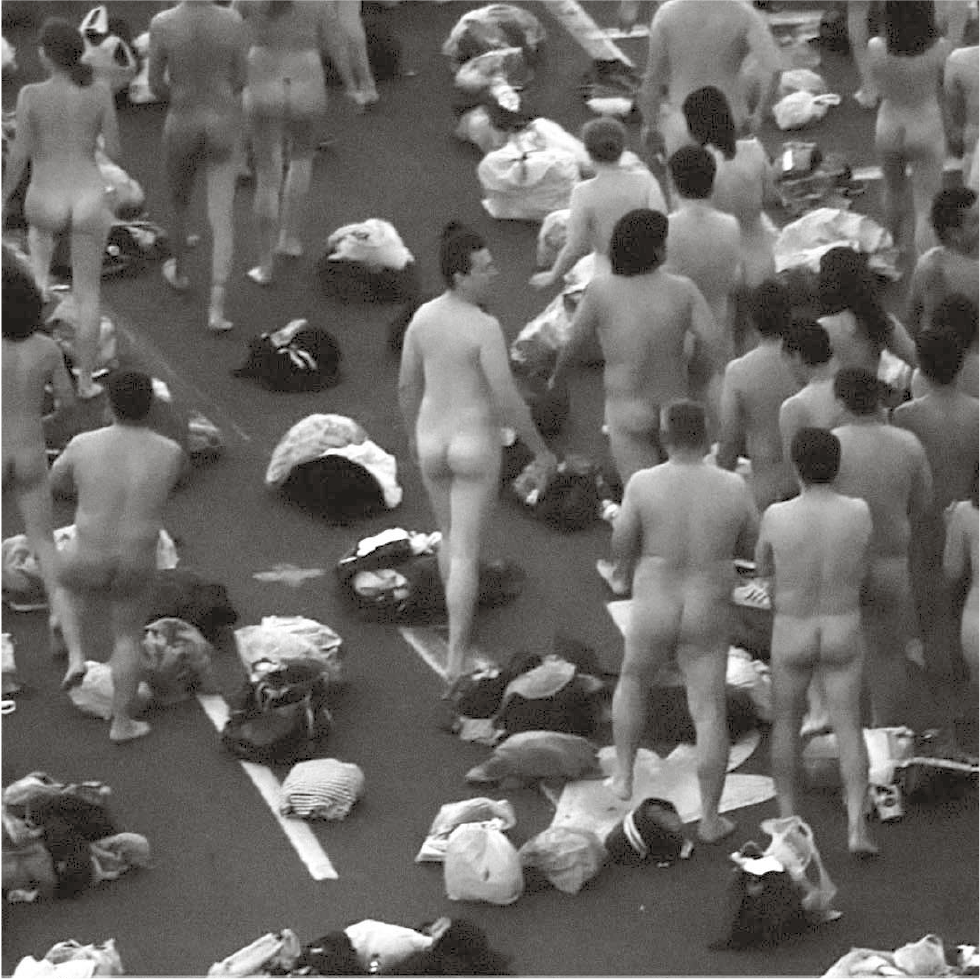
Regardless of the political, social and cultural transformations that the city has undergone, the Zócalo has always been a place of congregation, even in Aztec times. The void of the Zócalo presents an arena where anything can happen. Like any other square in the world, it is a site of political demonstrations and rallies. Every mass march either begins or ends in el Zócalo. However, the Zócalo is also a location for commerce, for gathering and for art. In 2007 photographer Spencer Tunick assembled approximately 19,000 nude bodies in the plaza in order to stage one of his pieces.2 We must remember that art does not exist in a void, it always speaks to its context and that frame of reference is what gives it meaning. Getting people naked in Barcelona has a different resonance than in a city like Mexico, which is still living under the weight of a patriarchal past, conservative traditions, Catholicism’s influence, machismo culture and a high degree of violence. There is no doubt that this is because of our complex historical baggage, but should it be exclusively attributed to our colonial past? Or might it be that its origins are even more intricate than we think?

PRE-HISPANIC SEXUALITY
You have taken in the thrilling sensation of the Zócalo, by now endorphins are running through your bloodstream, you feel exhilarated, yet hazy. You know it is not the end, there is more to come. You walk towards the northeast corner of the Zócalo, where a few hundred metres off you will encounter the archaeological site of Templo Mayor, one of the most important religious buildings of the great Tenochtitlán, capital of the Mexica (or Aztec) empire.
For Mesoamerican civilisations, sexuality was undoubtedly related to the divine and necessary to maintain the cosmic balance. However, it is complex to fully grasp the notion each individual civilisation had of the erotic, and in the case that pertains to the grounds where we currently stand (Mexico City, once Tenochtitlán), to pinpoint the Aztecs’. It was the Spanish colonisers who, in the 16th century, began to write history and thus, much of what we know is via these chronicles, inevitably biased by the lens through which the Spanish conceived life, one tinted by Catholicism’s view of sexuality. Archaeological findings have helped widen our notion of the Mesoamerican conception of the erotic, though this particular field of research is still lacking in this respect (perhaps due to the fact that for a while the conservative moral values of contemporary Mexican society discouraged or obscured some of these findings).
THE SECRET ROOM
In 1921, a series of phallic objects from the Maya, Huasteca, Totonaca, Nahua, Zapoteca and Tarasca civilisations was amassed by the chief of the archaeology department at the National Museum (then located in the Centro Histórico on Calle Moneda). These artefacts, that exemplified the veneration of the phallus and the ritual value of sexuality for pre-Hispanic cultures, were placed in a secret salon within the confines of the museum, accessible only to a few. It is said that a private committee was even created to safeguard and study this scandalous assortment of objects. The rumour is that the archaeologists were aware of the value of the collection, but nonetheless did not think it something to be exhibited publicly. Regardless, in 1923 a Catalogue of the Secret Salon was published, referencing thirty-one stone pieces, forty-eight in clay, nine drawings, one cast and a photograph taken in 1890 in Huejutla, State of Hidalgo. Although there is much speculation about the whereabouts of the collection, it likely disintegrated in 1964 with the relocation of the museum to what we now know as Museo Nacional de Antropología on Avenida Paseo de la Reforma. Evidently, this narrative is full of gaps, but whether or not they once formed part of the secret salon, today an array of phallic pieces can be found in the museum (undoubtedly a must see in the city).

UNDER THE JACARANDA TREES
By now you probably need a break from the strenuous pace you’ve been having to keep up with. Across the street from the Anthropology Museum is the Bosque de Chapultepec, the largest urban park in Latin America. Even though its distribution is quite different, it is almost double the size of Central Park, measuring 678 hectares. Just like the Zócalo, we are also speaking of the public arena. However, Chapultepec is a space of a different temperament: there are usually no politics, people mind their own business; it is a place for relaxation and leisure, surely one of the city’s erogenous zones. Be that as it may, the sensuality of the park is different from the rest of the city: it requires less of you; you need but to lay under the Jacaranda trees and let nature do the work.
On any given day while strolling down the main avenue or along the trails, you can see young couples passionately feeling each other up – on tree trunks, on benches and on the grass, you name it – that is a kind of conduct that would usually be frowned upon. Here, if not promoted, it is at least tolerated, todo mundo se hace de la vista gorda. Even though you can observe young lovers engaging in passionate encounters, you will never see a girl sunbathing in a bikini as you might in other parks in the world, even during the warmest season of the year (April and May). We are ardent and concupiscent, only as long we perform under the blankets.
And speaking of romantic encounters, it is time for a more incendiary anecdote. Hope you had enough rest in Chapultepec, it is time to get dirty again.

THE WRESTLING WAS TO CONTINUE ELSEWHERE
The lucha libre is not only a mise en scène for sport and spectacle, but one in which much more can unravel, like a threesome, or an invitation to one. It was Sunday, we three were in the Arena México, the Mexican wrestling coliseum. It was the middle of the fight, the técnicos had just won the round; he cheered, she cursed (she was rooting for the rudos, I oscillated depending on which of the two I’d rather lead on). The rudos are usually portrayed as the villains, while the técnicos are the ‘good guys’ who tend to conform more to the rules of traditional wrestling. In the end, it is a gamble between good and evil.
When they asked me to join them for their Sunday outing I never imagined the day would end with an invitation to go to bed with them, and much less that the proposal would take place, not by the candlelight of some romantic restaurant over a glass of wine, but in the lucha libre, in the midst of the ecstasy of the fight, our bodies sticky with a mixture of sweat and cheap beer.
The lucha libre has become the embodiment of Mexican culture such that in 2018 it was declared Patrimonio Cultural Intangible de la Ciudad de México, a recognition granted by the Mexico City government in honour of paramount cultural manifestations. Charged with an array of symbolism, since its institutionalisation in the early 30s, lucha libre has transcended the ring to permeate the Mexican imaginary. In the 50s, famous luchadores like El Santo, Blue Demon and Mil Máscaras even became protagonists in films.
Perhaps the strongest symbolic element in the visual language of Mexican free-style wrestling is the mask. Contradictory in nature, it simultaneously attests and protects identity; it becomes a chance for transcendence; for the private to become part of the collective. Does the mask bring you closer or farther to you? Does it allow you to be yourself or someone else? The mask’s power even permeates the psyche of the spectator. You go to the lucha libre not only because you are a fan, but also because you want to scream, laugh, get drunk, cry, curse. The arena becomes a permissive place, where for once sensibility is not seen as a weakness (it’s a place where even machos can cry). You can wear any mask you want and even dare to do the thrillingly (but also the extremely vulnerable) thing of inviting someone into the intimacy of your and your partner’s bed.
We left the match before it ended, the wrestling was to continue elsewhere. The question was: who would play the role of the técnicos and who of the rudos. The words of the narrator echoed in my mind: ‘dos de tres caídas, sin límite de tiempo’ (two out of three falls,
no time limit).


THE ARENA AS MUSEUM
The lucha libre has also staged contemporary artworks. In the late 1990s, artist Carlos Amorales got hooked. He saw the ring not only as a symbol of our social constructs, but also as a mirror of the contemporary art world. From 1999 to 2003 he worked on Amorales vs. Amorales, a series of performances of wrestling matches that took place in arenas and museums, establishing a parallel between the luchador and the artist, the promoter and the gallerist. Both artist and wrestler were sucked into the gap between reality and fiction, slowly chewed up by the voracious and insatiable monster that dwells within that, and spat out to perform. Who reappears? Amorales or Amorales? One must assemble a mask. How do we return to art making after this? Choiceless, we get sucked back into the void. It is from this ambiguity that we are able to make. How much room is there for transformation in this seductive cycle from which we cannot escape?

THE HOTEST QUEER ARTIST IN TOWN
Ana Segovia, one of the hottest queer artists in town, also has a piece that involves a fighter, in this case a boxer. This painting shows a boxer’s torso positioned to throw a punch, the only hint of context is a backdrop of grass with tiny yellow flowers. What is the boxer striking at? As in much of Segovia’s body of work, the image of the boxer stems from a Mexican film about a boxer fighting against all odds to secure his manhood. In Segovia’s work, two scars are heavily painted onto the boxer’s chest, alluding to the transformation of the body. The artist’s construction of the pictorial field mirrors the construction of identity. Her paintings are at once playful and seductive, but always full of tension. Like bodies, Segovia’s works constantly perform, struggling to conform identity. Inevitably, desire comes into play. Her pieces make us question our true impulses before we were taught to aspire. Luis Cernuda’s words come to mind: ‘desire is a question for which there is no answer.’

THE EROTICS OF SPACE
Regardless of what you might be thinking up to now, Mexico City’s erotism is not all excess. While the appeal of the lucha libre’s baroqueness is undeniable, there is nothing more seductive than Luis Barragán’s architecture. Whether you stand inside one of his houses, drive by his monumental Torres de Satélite or walk the grounds of Cuadra de San Cristobal, there is something sublime to the way Barragán conceived space and how we inhabit it. Even though his architecture is full of symbolic references, it wouldn’t seem so at first glance due to the purity and simplicity of his forms. Colour is paramount, it is achieved via a poignant use of terracotta and a unique pink along with an artful placement of windows and skylights that allow for an intricate play of light. It is as if he paints the room with light, always considering what sort of illumination would suit the mood of that specific space, each chamber requiring different lighting appropriate to its distinct use. Aware of the demanding rhythm of the city, through his architecture, Barragán encouraged turning away from the apparent appeal of the exterior and instead turning within, to the enchantment of interior spaces and nature. After all, what could be more erotic than our own private spaces? After bringing you in he always brought you out again – not back to the city, but to his spellbinding gardens through giant windows.


LA ÚLTIMA Y NOS VAMOS*
* ‘The last one and we leave’.
It is time for lunch. But not any lunch (erase your ideas of the Western midday meal), we are talking about the Mexican comida, one of the most complex and alluring rituals that epitomises Mexico’s elaborate and sexy rituals around food, drink and gathering. It usually starts at 3pm, but there is really no knowing when it will end. We call this la sobremesa (literally ‘the after table’). After everyone has finished their meals, the sign that it has begun is when people start ordering carajillos (a shot of espresso and a shot of Licor 43). After that anything goes. The sobremesa is somewhat like Luis Buñuel’s film The Exterminating Angel (1962), it goes on and on (and on) and for some inexplicable reason you just can’t seem to leave. So, if you are about to sit down with a local for lunch, cancel any sight-seeing you had planned for the rest of the day (you will certainly get much more out of this experience than out of any ‘must see’ spot) – the earliest your companion will let you is late at night, if at all.
The eroticism of the sobremesa beats out even the seductiveness of the night.


THE ALLURE OF MEZCAL
Any comida must start with an aperitif, tequila or mezcal are usually the way to go, often with a beer as a chaser (risky business right there). For those of you who have had tequila but have never tried mezcal, I like to say, ‘mezcal is to tequila what smoked ham is to ham.’ There is something to drinking mezcal that might even trump the allure of drinking wine in a Parisian café. It is simultaneously refined and raw, thrilling and calming; not only can a sip turn you on, but watching someone do it can be quite riveting. Mezcal is often served in a veladora, a small glass cup that once contained a candle, but not just any candle, one ignited as a symbol of devotion for a saint. There is a reason why when drinking your last sip of mezcal, you undoubtedly see a cross on the bottom of the glass.

IT’S LIKE SEX IN YOUR MOUTH
Even though mezcal could well stand on its own, there is nothing more delectable than pairing it. Its beauty is that it can go well next to anything. My personal favourite is mezcal and mole: the complexity and intensity of the flavours make it an irresistible mix, so much so that after every bite you are tempted to sip your mezcal (watch out if you do, it goes fast). If you are looking for a crazy night in town, remember stimulating your palette/appetite is the best way to awaken the senses. Make sure your meal includes at least a few pre-Hispanic aphrodisiacs. Although there are an array to choose from, three of the most easily found (and kinky) are: vanilla (improves circulation, an excellent invigorator), red peppers (elevate body temperature and contain Capsaicin, a substance that liberates endorphins) and avocado (not only is it extremely energetic, but it turns out that its name in Náhuatl [indigenous tongue], ahuacatl, actually means testicle). And remember, sharing is caring. Order different plates and try different things, the greater the risks the greater the rewards.